
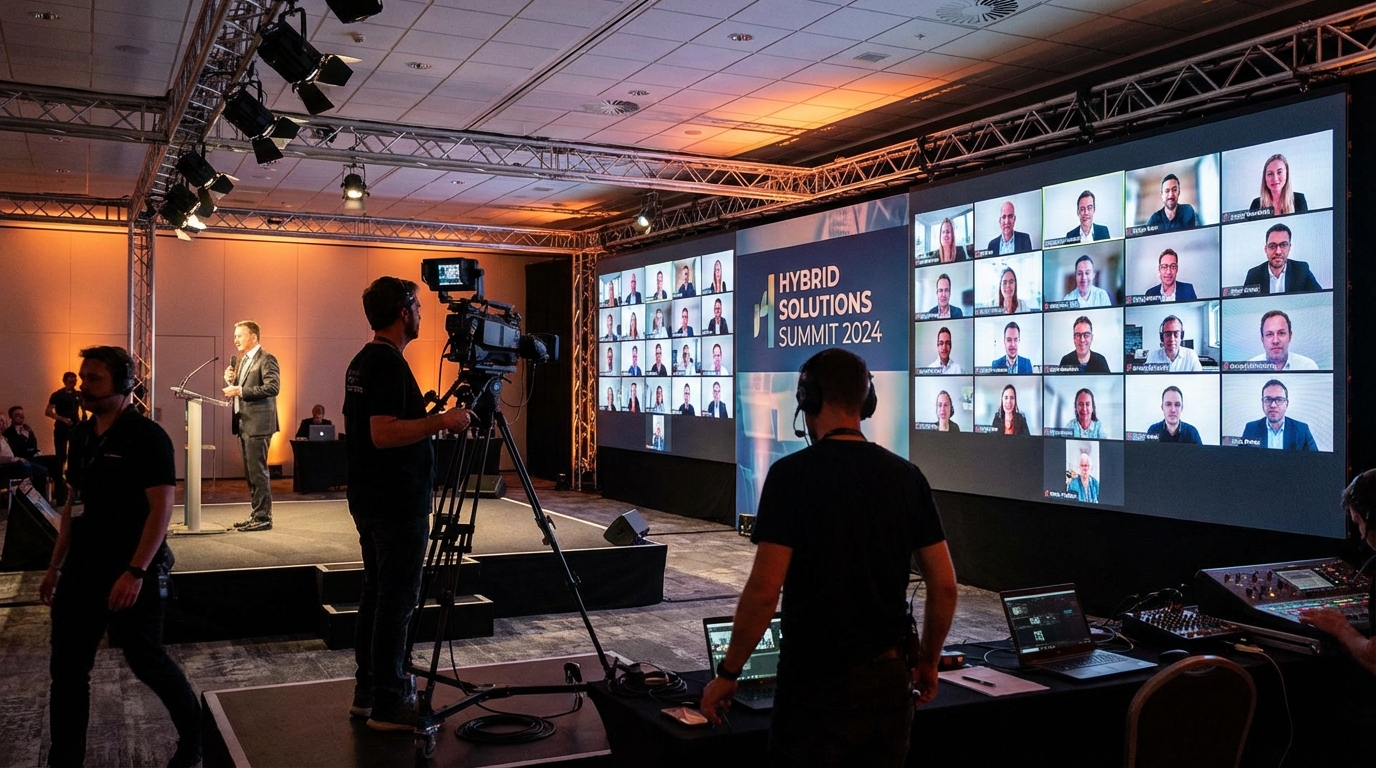
Hybrid Events in 2026: The AV Production Guide for In-Person + Virtual
Hybrid events are no longer an experiment. They're a permanent fixture of the corporate event landscape, and the organizations that treat them as a core competency — not a compromise — are the ones delivering the most impactful experiences. But producing a hybrid event that truly works for both audiences requires more than plugging a webcam into a laptop and hoping for the best. It demands a deliberate AV strategy, the right equipment, skilled operators, and a fundamentally different approach to event design.
This guide breaks down everything you need to know about hybrid event production in 2026, from the essential equipment to the venue requirements, audience engagement strategies, common pitfalls, and realistic budget expectations. Whether you're planning your first hybrid event or refining a model you've already run, the principles here will help you deliver a seamless experience for every attendee — regardless of where they're watching from.
What Makes a Hybrid Event Different from Live Streaming
The most common misconception about hybrid events is that they're simply an in-person event with a camera pointed at the stage. That's live streaming — and there's an important distinction. A live stream or webcast broadcasts your in-person event to a remote audience who watches passively. It's a one-directional experience. The remote viewers are spectators, not participants.
A true hybrid event creates two parallel experiences that are intentionally designed for their respective audiences. The in-person attendees benefit from the energy of the room, face-to-face networking, and direct interaction with speakers. The virtual attendees receive a production-quality broadcast with camera angles optimized for screens, dedicated moderation, interactive tools like polls and Q&A, and opportunities to participate that go beyond just watching a stream. The key difference is intentionality: every element of the event is designed with both audiences in mind, not just the one physically in the room.
This dual-audience approach affects every AV decision you make. Camera placement, audio routing, content switching, and platform selection all need to serve two distinct experiences simultaneously. That complexity is exactly why hybrid events require more planning, more equipment, and more skilled operators than either a purely in-person or purely virtual event.
Essential AV Equipment for Hybrid Events
The equipment stack for a hybrid event is substantially more involved than a standard in-person setup. Here's what you need and why each element matters.
Cameras
A single wide-shot camera will not deliver a watchable experience for your virtual audience. At minimum, plan for two to three PTZ (pan-tilt-zoom) cameras or operated broadcast cameras: one for a wide shot of the stage, one for a tight shot of the current speaker, and ideally a third for audience reaction shots or alternative angles. PTZ cameras are popular for hybrid because they can be remotely controlled by a single operator, keeping crew costs manageable while still providing dynamic camera work. For high-profile events, manually operated cameras on tripods or jibs deliver more cinematic results.
Video Switching and Encoding
All those camera feeds, plus presentation slides and any pre-produced video content, need to be mixed into a single program output for the virtual audience. A hardware video switcher handles this in real time, allowing the technical director to cut between sources, add lower-third graphics, and manage picture-in-picture layouts. The program output then feeds into a hardware or software encoder that converts the video signal into a streaming-compatible format and pushes it to your chosen platform. Professional-grade encoders offer better stability, lower latency, and higher quality than laptop-based software encoding.
Audio Feeds
Audio is the single most critical element for your virtual audience. Remote attendees will tolerate imperfect video far longer than they'll tolerate muddy, echo-laden, or inconsistent audio. The audio feed sent to the streaming encoder must be a clean, dedicated mix — separate from the in-room PA mix. This means your audio engineer is building and managing two distinct mixes simultaneously: the house mix for the room speakers and the broadcast mix for the stream. The broadcast mix typically has different equalization, compression, and level balancing than the room mix, because headphones and laptop speakers reproduce sound very differently than a line array in a ballroom.
Confidence Monitors and Teleprompters
Speakers at hybrid events need visual cues that go beyond what's typical at in-person events. A confidence monitor facing the stage shows presenters what the virtual audience is seeing, including any slides, camera feeds, or lower-third graphics. If remote attendees are asking questions via a virtual platform, those questions need to surface on a monitor the speaker or moderator can see. Without these feedback loops, the in-room and virtual experiences quickly diverge, and the remote audience feels like an afterthought.
Venue Requirements for Hybrid Production
Not every venue is hybrid-ready, and discovering this after you've signed the contract is a costly mistake. Here are the venue factors that directly impact hybrid production quality.
Internet Bandwidth
A reliable, high-speed internet connection is non-negotiable. For a single-stream hybrid event at 1080p, you need a minimum of 10 Mbps dedicated upload bandwidth — and that's a floor, not a target. For multi-stream or 4K output, plan for 25 to 50 Mbps upload. Critically, this bandwidth must be dedicated to the production team, not shared with attendee Wi-Fi, venue operations, or the hotel's guest network. A hardwired Ethernet connection from the venue's main internet trunk to your production area is the standard. Never rely solely on Wi-Fi for your stream output.
If the venue's internet infrastructure is insufficient, your AV team can bring in a bonded cellular solution or a temporary dedicated fiber line, but both add cost and lead time. Evaluate the venue's connectivity early and discuss options with your event Wi-Fi and networking provider well before event day.
Separate Audio Mixes
As mentioned in the equipment section, hybrid events require dual audio mixes. This means your venue needs to accommodate a more extensive audio console and additional signal routing infrastructure. The physical space at front-of-house (where your audio engineer sits) needs room for a larger mixing console or a secondary mixing position dedicated to the broadcast feed. Plan for this in your venue floor plan and ensure there are sufficient audio cable runs between the stage, the PA system, and the streaming/encoding station.
Production Area and Sightlines
Hybrid production requires a dedicated technical operations area — sometimes called a "production village" or "tech world" — where the streaming engineer, video switcher operator, and graphics operator work. This area needs power, table space, monitor mounts, and ideally a direct sightline to the stage (or a video feed from the room cameras). In venues where space is tight, this production area is sometimes set up in an adjacent room connected via video and audio cable runs, which works but requires careful planning for communication between the production team and the stage manager.
Engaging Remote Attendees: Beyond the Passive Stream
The biggest risk in hybrid events is losing the virtual audience. Remote attendees face constant distractions — email, Slack, their phones, their kids — and if the experience feels like watching a low-quality security camera feed of someone else's event, they'll disengage within minutes. Engagement isn't a nice-to-have; it's the entire point of going hybrid instead of just posting a recording later.
Virtual Q&A
Give remote attendees a clear, moderated channel to ask questions. The best hybrid events have a dedicated virtual moderator who monitors the Q&A feed, curates questions, and either reads them aloud to the room or passes them to the on-stage moderator. This creates a bridge between the two audiences. Remote attendees feel heard, and in-person attendees benefit from the broader perspective that virtual participants bring.
Live Polls and Surveys
Real-time polling platforms that work simultaneously for in-room and remote attendees are one of the most effective engagement tools. When a speaker poses a poll question and results populate on screen from both audiences combined, it creates a shared experience that dissolves the barrier between physical and virtual. Platforms like Slido, Mentimeter, and Poll Everywhere are designed for exactly this use case.
Virtual Breakout Rooms
For multi-session events, consider offering virtual-only breakout sessions or mixed breakouts where in-room and remote attendees join the same discussion. Virtual event platforms like Hopin, vFairs, and Zuddl offer built-in breakout room functionality that can mirror or complement the in-person breakout track. This gives remote attendees the networking and small-group interaction that's otherwise exclusive to the physical event.
Dedicated Virtual Emcee
One of the most impactful investments you can make is assigning a dedicated host or emcee for the virtual experience. This person acknowledges the remote audience, narrates transitions, fills dead time during in-room breaks, and creates a sense of community among virtual attendees. Without a virtual emcee, the stream goes silent during room transitions, and remote attendees wonder if the feed is broken.
Common Hybrid Event Pitfalls
After producing hundreds of hybrid events, we've seen the same mistakes surface repeatedly. Avoiding these will put you ahead of most organizations attempting hybrid.
- Treating virtual as an add-on. When hybrid is an afterthought bolted onto an in-person event plan, the virtual experience suffers. Design for both audiences from day one.
- Relying on venue Wi-Fi for streaming. Shared Wi-Fi networks are unreliable and subject to bandwidth contention. Always use a hardwired, dedicated connection for your production stream.
- Using laptop microphones for the broadcast feed. A laptop mic across the room captures echo, HVAC noise, audience chatter, and a faint version of the speaker. Use a direct audio feed from the mixing console to your encoder.
- Ignoring time zones. If your virtual audience spans multiple time zones, schedule key content at times that work for the broadest audience, and make recordings available promptly for those who can't attend live.
- No rehearsal for the virtual experience. You rehearse the in-room presentation. You need to equally rehearse the stream output — checking camera angles, graphics, audio levels, platform functionality, and the transition between segments as they'll appear to the remote viewer.
- Forgetting the virtual audience during networking time. In-room attendees break for coffee and conversation. Virtual attendees stare at an empty room or a "we'll be right back" slide. Plan virtual networking activities, facilitated discussions, or content to fill these gaps.
Why a Dedicated Tech Team Matters for Hybrid
A standard in-person event can often be managed by a small AV crew: an audio engineer, a video tech, and perhaps a lighting operator. Hybrid events add an entirely separate production layer. You now need someone operating the video switcher for the stream, someone managing the encoder and monitoring stream health, someone running virtual platform tools (Q&A, polls, breakouts), and ideally a technical director overseeing the entire broadcast output.
These are specialized roles that require specific skills. The person switching cameras for a live stream needs broadcast instincts — knowing when to cut to the speaker, when to show a wide shot, when to feature the slides, and how to create a visually engaging program. The streaming engineer needs to troubleshoot encoder settings, bitrate fluctuations, and platform-specific issues in real time. Asking your in-room AV tech to "also handle the stream" is a recipe for a degraded experience on both sides.
This is why working with an AV partner who has dedicated hybrid event production experience matters. The workflow, the crew structure, and the contingency planning for hybrid are fundamentally different from traditional in-person AV, and experience in this specific discipline translates directly to a smoother event.
Budget Planning: Hybrid vs. Fully In-Person
Let's address the question every event planner asks: how much more does hybrid cost? The honest answer is that a well-produced hybrid event typically adds 30 to 60 percent to your AV budget compared to the same event produced purely in-person. Here's where that additional investment goes:
- Camera package. Two to four PTZ or operated cameras, plus rigging and cabling. Plan for $2,000 to $8,000 depending on the number and type of cameras.
- Video switching and encoding. Hardware switcher, encoder, graphics system, and the operator to run them. $1,500 to $5,000 per day.
- Streaming platform. Licensing fees for virtual event platforms range from a few hundred dollars for basic webinar tools to $5,000 or more for full-featured platforms with breakout rooms, networking, and analytics.
- Dedicated internet. If the venue's connection is insufficient, bonded cellular or temporary fiber runs add $500 to $3,000.
- Additional crew. A streaming engineer, virtual platform moderator, and potentially a virtual emcee. $1,500 to $4,000 per day for additional crew.
- Broadcast audio mix. A separate mix position or split console setup, plus the engineer's time to manage it. Typically $500 to $1,500 additional.
For a mid-size corporate event (300 to 500 in-person attendees, 200 to 1,000 virtual), a realistic hybrid AV budget range is $15,000 to $40,000 on top of your base in-person AV costs. That's a meaningful investment, but consider the ROI: hybrid events expand your reach without the per-attendee cost of travel, lodging, and meals. A virtual attendee costs a fraction of an in-person one, and the content reaches a far wider audience.
For organizations that run quarterly or annual events, the hybrid infrastructure also gets more efficient over time. Templates, platform configurations, and crew workflows established for one event carry over to the next, reducing planning time and cost for subsequent productions.
Make Hybrid Work for Both Audiences
The hybrid event model is here to stay because it solves a real problem: not everyone can be in the room, but everyone deserves a meaningful experience. The organizations that invest in proper AV production, dedicated crews, and thoughtful audience engagement for both sides of the equation are the ones whose events people actually want to attend — whether they're in the front row or on their laptop a thousand miles away.
If you're planning a hybrid event and want to ensure both your in-person and virtual audiences get a production-quality experience, reach out to our team. We'll help you build the right equipment plan, crew structure, and engagement strategy for your specific event — no guesswork required.
Astro Audio Visual Team
Expert AV production for corporate events in San Antonio, Austin & Houston.