
The Complete Guide to Stage Lighting for Corporate Events
Lighting is one of the most powerful tools in corporate event production, yet it remains one of the most misunderstood. Event planners routinely invest significant budget into audio systems, video walls, and scenic design while treating lighting as an afterthought — something that simply needs to be "bright enough." That's a missed opportunity. Professional stage lighting doesn't just illuminate your presenters. It shapes the emotional experience of your entire event, directs audience attention, reinforces your brand, and determines how polished your production looks on camera and in person.
Whether you're planning a 200-person general session, a 1,500-seat keynote, or an elegant awards gala, this guide will walk you through the types of lighting available, how to use them effectively for different event formats, the most common mistakes planners make, and how to work with your AV team to get a result that matches your vision.
Why Lighting Matters More Than Most Planners Think
Consider the last corporate event you attended. You probably remember the speaker, the content, and the overall energy in the room. What you may not have consciously noticed — but certainly felt — was the lighting. When a keynote speaker steps onto a stage bathed in warm, focused light while the audience seating dims to a soft glow, it creates an immediate sense of importance and attention. When a gala dinner transitions from bright networking light to intimate amber tones as guests take their seats, it signals a shift in mood without a single word spoken.
Lighting works on a psychological level. It guides where people look, how they feel, and how they perceive the quality of the event. A well-lit stage makes speakers look professional, confident, and authoritative. A poorly lit stage — uneven washes, harsh shadows across faces, or unflattering color temperatures — makes even the most polished presenter look amateurish. This effect is amplified significantly when cameras are involved. If your event is being recorded or live-streamed, lighting quality directly determines video quality. No amount of post-production editing can fix a speaker whose face is half in shadow because the lighting wasn't designed for camera.
Beyond the stage, lighting defines the atmosphere of the entire venue. It separates zones, creates wayfinding cues, establishes brand presence through color, and transforms generic hotel ballrooms into immersive environments that feel intentional and curated. Investing in lighting is investing in how your audience experiences every moment of your event.
Types of Corporate Event Lighting
Understanding the different categories of lighting will help you communicate more effectively with your AV team and make informed decisions about where to invest your budget.
Wash Lights
Wash lights are the workhorses of any stage lighting rig. They produce a broad, even spread of light that "washes" the stage in color. In corporate events, wash lights serve two primary purposes: illuminating presenters so the audience (and cameras) can see them clearly, and establishing the overall color temperature of the stage. A warm white wash makes speakers look natural and approachable; a cool blue wash creates a modern, high-tech atmosphere.
Modern LED wash fixtures offer full RGBW (red, green, blue, white) color mixing, which means a single fixture can produce virtually any color. This flexibility lets your lighting designer shift the entire stage mood between segments — corporate blue for the CEO's address, warm amber for a fireside chat, vibrant brand colors for a product reveal — without physically changing any equipment.
Spotlights and Follow Spots
Spotlights produce a focused, intense beam of light trained on a specific area or person. They're essential for keynote presentations where you want to isolate the speaker from the background and create a sense of prominence. Follow spots are operator-controlled spotlights that track a presenter as they move across the stage, keeping them in a pool of bright, flattering light.
For corporate events with multiple speakers, spotlights can be pre-positioned to cover different areas of the stage — the podium, the center-stage mark, a panel seating area — and switched between as the program progresses.
Uplighting
Uplighting places fixtures at ground level, aimed upward along walls, columns, drape, or architectural features. It's one of the most cost-effective ways to transform a venue space because it adds dramatic depth and color to otherwise flat, neutral surfaces. A row of wireless LED uplights along a ballroom wall, set to your brand color, instantly makes the room feel more intentional and polished.
Uplighting is used extensively in galas, receptions, and networking spaces. Battery-powered wireless fixtures have made uplighting remarkably flexible — they can be placed anywhere without running cables, repositioned quickly between event phases, and programmed to change color throughout the evening.
Gobos and Custom Pattern Lighting
A gobo (short for "goes before optics") is a stencil or template placed inside a lighting fixture to project a pattern, logo, or texture onto a surface. Gobos are a staple of corporate event lighting because they allow you to project your company logo onto the stage floor, a wall, or a screen — adding branded visual presence without any additional set construction.
Beyond logos, gobos can project textures (like dappled light, geometric patterns, or abstract shapes) onto walls, ceilings, and floors to create visual interest and depth. A ballroom wall washed in blue uplighting with a subtle geometric gobo overlay looks infinitely more polished than the same wall with flat color alone. Custom gobos can be fabricated in steel (for bold, single-color patterns) or glass (for full-color, photographic-quality images) and are relatively inexpensive to produce.
Intelligent Moving Lights
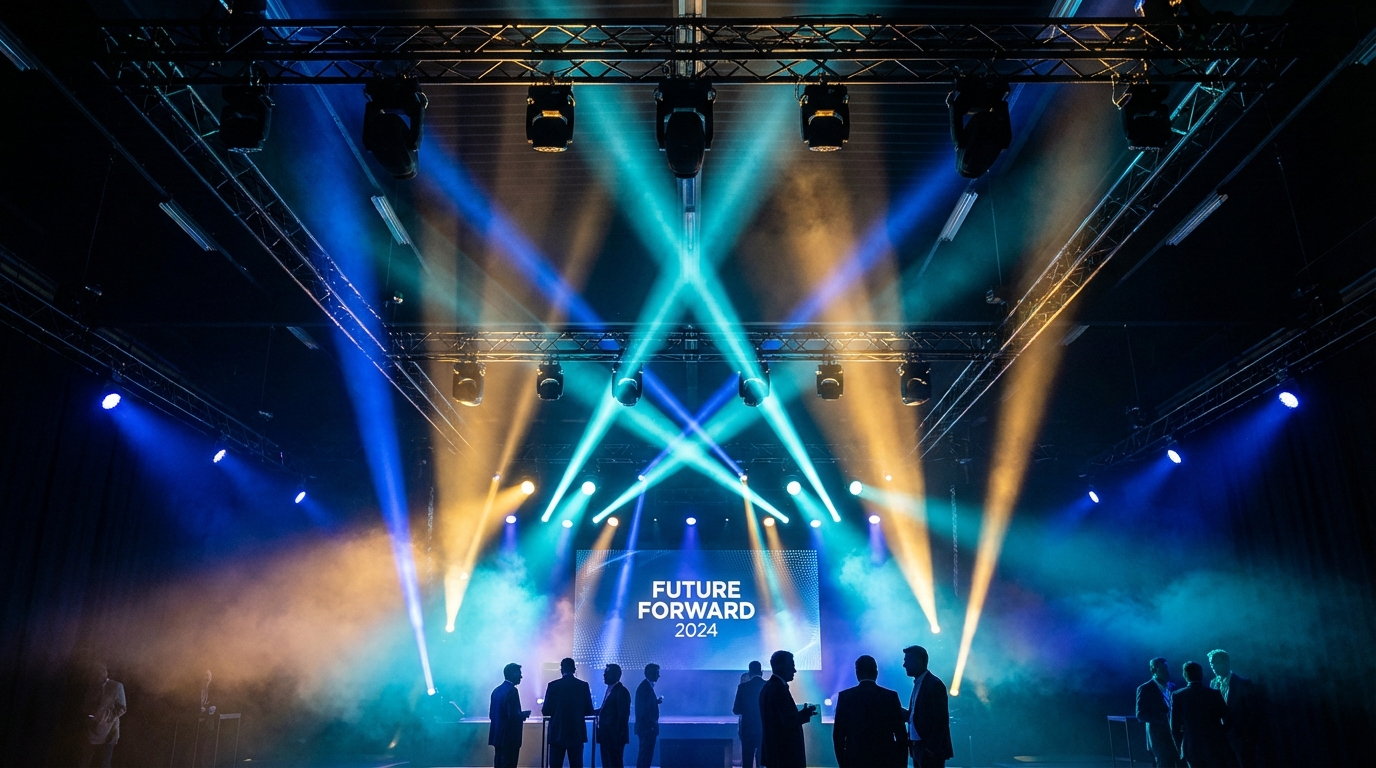
Intelligent moving lights — also called moving heads — are motorized fixtures that can pan, tilt, change color, switch gobos, adjust focus, and shift beam intensity, all under DMX or network control. They're the most versatile and visually dramatic fixtures in a lighting designer's toolkit.
In corporate events, moving lights are used for dynamic looks: sweeping beams through haze during a product launch reveal, shifting colors and positions between presentation segments, creating aerial effects during entertainment acts, and providing automated follow-spot functionality in venues where a traditional follow-spot position isn't available. While they carry a higher rental cost than static fixtures, even a small number of moving lights can add significant production value and visual energy to your stage design.
LED Strips and Accent Lighting
LED strip lighting (also called tape light or ribbon light) consists of thin, flexible strips of LEDs that can be mounted along set pieces, under staging platforms, behind scenic panels, or along architectural features. In corporate events, LED strips are used to add accent lines of light and color to stage risers, lectern bases, furniture edges, and scenic elements. They create a modern, high-tech aesthetic and can be programmed to match your brand palette or change dynamically throughout the event.
Lighting for Different Event Types
The lighting approach that works for a keynote general session is very different from what a gala dinner requires. Here's how to think about lighting for the most common corporate event formats.
General Sessions and Keynotes
The priority in a general session is visibility and focus. Presenters need to be well-lit with even, front-facing wash light that eliminates harsh shadows. If the session is being recorded or streamed, lighting becomes even more critical — cameras require consistent, well-balanced illumination to produce a quality image. A common general session lighting setup includes front wash for the stage area, back light to separate the speaker from the background, side light for depth and dimension, and house lighting control to dim the audience area during presentations.
Color accents on the stage set — LED strips along the base of the set wall, a branded gobo on the floor, or colored wash on scenic panels — add production value without distracting from the content.
Galas and Awards Ceremonies
Gala lighting is about atmosphere and elegance. The room itself becomes part of the design. Extensive uplighting along the walls sets the color palette, while pin-spot lighting on table centerpieces creates visual focal points throughout the dining space. The stage may feature more dramatic looks: deeper colors, moving light effects during entertainment segments, and carefully designed lighting cues that transition between dinner service, presentations, and performances.
For award presentations, a follow spot isolating each recipient as they approach the stage adds a sense of occasion and importance. Color transitions between award categories or program segments help structure the evening visually.
Breakout Sessions and Workshops
Breakout rooms don't need the dramatic lighting of a main stage, but they do need thoughtful lighting control. The ability to dim the house lights for presentations and bring them back up for discussions is essential. If the room has a presenter area, even a simple pair of wash fixtures focused on the speaker makes a noticeable difference in the audience's ability to focus and the quality of any camera feed.
Outdoor Events
Outdoor events present unique lighting challenges. During daylight hours, natural light dominates and your stage lighting is primarily about supplementing and filling shadows on speakers' faces. As the sun sets, your lighting rig transitions to become the primary source of illumination for the stage and audience areas. This transition requires planning, programming, and rehearsal.
Outdoor events also need to account for architectural and landscape lighting, pathway and safety lighting for attendees moving between areas, and weather protection for fixtures (rain covers, IP-rated enclosures). Wind can affect truss-mounted lighting, so structural engineering considerations matter more outdoors than in a ballroom.
Common Lighting Mistakes
After years of producing corporate events across Texas, we've seen the same lighting mistakes repeated by planners at every budget level. Avoiding these pitfalls will immediately elevate the quality of your production.
Relying on Venue House Lights Alone
Hotel and convention center house lighting is designed for general illumination — even, flat overhead light that serves a ballroom for banquets, meetings, and everything in between. It is not designed for presentations, stages, or creating atmosphere. House lights cast unflattering downward shadows on faces, cannot be focused or directed, produce a fixed color temperature (usually a cold fluorescent tone), and give the room a generic, uninspired feel. Even a modest investment in dedicated stage wash and a few uplights dramatically outperforms house lights alone.
Ignoring Camera Lighting Requirements
If any part of your event is being photographed, recorded, or live-streamed, lighting for camera must be considered separately from lighting for the live audience. What looks perfectly fine to the naked eye can look terrible on camera — harsh shadows, blown-out highlights, color casts from mixed light sources, and flickering from incompatible dimming frequencies. Communicate early with your AV team about which segments will be captured on camera so the lighting designer can plan accordingly.
Over-Designing the Lighting
More isn't always better. A common mistake at well-funded events is programming too many lighting cues, too many color changes, and too much movement. When the lights are constantly shifting, it becomes distracting and can undermine the very content you're trying to highlight. For most corporate events, restraint is more effective than spectacle. Save the dynamic, high-energy lighting looks for moments that deserve them — opening reveals, product launches, entertainment acts — and keep the rest clean, consistent, and professional.
Not Allocating Time for Programming
Lighting needs to be programmed, focused, and rehearsed. Each fixture must be aimed at its correct position, lighting cues need to be built in the console and timed to the program, and the full sequence needs to be run through at least once before the audience arrives. Planners who schedule lighting setup on the same day as the event, with no dedicated focus and programming time, end up with lighting that looks generic and unrehearsed.
Forgetting About Haze
Beam effects from moving lights and spotlights are only visible when there's something in the air for the light to illuminate. A thin layer of atmospheric haze makes light beams visible, adds depth to the room, and creates the cinematic look that attendees associate with high-production events. Without haze, even expensive intelligent lighting fixtures produce invisible beams that only appear as dots on the floor. If your lighting design includes any beam effects, discuss haze machines with your AV team and confirm the venue allows it (most do, but fire alarm systems may need to be coordinated with venue management).
How to Communicate Your Vision to Your AV Team
You don't need to know the technical specifications of every lighting fixture to get great results. What your lighting designer needs from you is a clear understanding of the mood and feeling you want to create. Here's how to communicate effectively:
- Gather visual references. Collect photos and videos of events whose lighting you admire. Pinterest boards, Instagram posts, or screenshots from corporate event highlight reels give your designer a concrete starting point. A single reference image communicates more than paragraphs of description.
- Define the mood for each segment. Describe how you want the audience to feel during each phase of the event. "High energy and exciting" for the opening, "focused and professional" for the keynote, "warm and celebratory" for the awards — these emotional cues translate directly into lighting decisions.
- Share your brand guidelines. Provide your brand color codes (Pantone, hex, or RGB values). A skilled lighting designer can match your brand colors precisely using LED fixtures, ensuring visual consistency between your event environment and your branded materials.
- Identify must-have moments. If there are specific moments that need special treatment — a product reveal, a CEO entrance, an award presentation — call these out explicitly. Your designer can build dedicated lighting cues for these high-impact moments.
- Be honest about your budget. A transparent budget conversation allows your lighting designer to make smart trade-offs. They can focus resources on the moments and spaces that matter most and suggest cost-effective alternatives for less critical areas.
Budget Considerations
Lighting costs for corporate events vary widely depending on the venue size, the complexity of the design, the number of fixtures required, and whether the event involves camera work. Here's a practical framework for thinking about your lighting budget.
Essential Tier
At the essential level, you're covering the fundamentals: stage wash lighting so speakers are visible, basic house light control, and perhaps a handful of uplights to add color to the room. This level is appropriate for straightforward meetings, conferences, and presentations where the focus is entirely on content delivery. Even at this tier, the difference between professional lighting and relying on venue house lights is significant.
Enhanced Tier
The enhanced tier adds branded gobos, more extensive uplighting, back lighting for speaker separation, dedicated camera lighting if recording or streaming, and programmed lighting cues that transition between event segments. This is the sweet spot for most corporate conferences and mid-size general sessions. It delivers a polished, professional look that elevates the perceived quality of the event without requiring a massive investment.
Premium Tier
Premium lighting designs incorporate intelligent moving lights, atmospheric haze for beam effects, complex multi-cue programming, follow spots, LED strip accents on scenic elements, and comprehensive room transformation with extensive uplighting. This tier is typical for large-scale general sessions (500+ attendees), galas, product launches, and events where visual impact and brand perception are paramount.
Where to Save and Where to Invest
If your budget is limited, prioritize stage wash and front light above everything else — this has the biggest impact on how your event looks and feels. Uplighting is the next best investment for its cost-to-impact ratio. Gobos add significant brand presence for a relatively small additional expense. Moving lights and complex programming should be reserved for events where the budget supports them fully, because a half-executed design looks worse than a simpler design done well.
The most important budget consideration is labor. A skilled lighting designer and operator who can maximize the impact of a modest fixture package will always deliver better results than an expensive rig programmed by someone without experience. When allocating your lighting budget, don't shortchange the human expertise.
Let Your Lighting Tell the Story
Great corporate event lighting doesn't call attention to itself — it makes everything else on stage look better. It ensures your speakers are presented at their most professional, your brand is represented with precision, and your audience feels the energy and emotion of every moment. Whether you're planning an intimate executive meeting or a 3,000-person national conference, lighting is the element that ties the entire production together.
Ready to discuss lighting for your next event? Contact our team for a free consultation. We'll assess your venue, understand your vision, and design a lighting package that delivers exactly the impact your event deserves.
Astro Audio Visual Team
Expert AV production for corporate events in San Antonio, Austin & Houston.